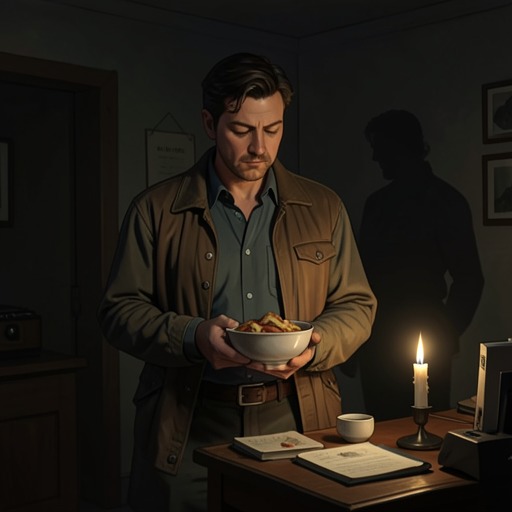
Lhasaero and the priest compete for the bread of sacrifice
Lazarillo de TormesThe struggle between Lázaro and the priest over the chest of consecrated bread is a tightly staged contest between hunger and household control. Lázaro first turns a tinker’s key into access to the locked store, then invents a rat infestation to conceal the bread he takes. As the priest patches the chest and sets a trap, Lázaro answers with new evasions until a key kept in his mouth whistles in his sleep. Mistaking the sound for a snake, the priest hits him on the head; the key exposes the theft, and once recovered Lázaro is dismissed. The chest becomes both a food store and the changing terrain of a battle in which necessity teaches the servant to outwit, and finally to suffer from, his master’s vigilance.
Hunger and the Locked Chest
By the time the episode begins, Lázaro has already had two masters who made him go hungry. He fears that leaving the priest may only bring a worse situation, and cannot decide whether escape is worth the risk. That hesitation gives way when a tinker happens to call while the priest is away and asks whether anything needs repairing. Lázaro asks him to mend the boy himself, then tells him that he has lost the key to the chest and fears a beating. He asks the tinker to try his keys, promising payment if one fits.
The chest holds consecrated loaves. When the right key opens it, Lázaro sees bread where deprivation had left him expecting nothing. He cannot pay in money, so he lets the tinker take a loaf as his reward. At first he does not touch the remaining bread, partly to avoid making the loss obvious and partly because possession alone seems to promise that hunger will no longer reach him. The next day, when the priest leaves, Lázaro opens his newly secured store, eats a loaf rapidly, and carefully locks the chest again. For a brief moment, the locked chest has become his private refuge.
That reprieve lasts only a few days. The priest counts the loaves, notices that some are missing, and announces that there are nine and a piece left. Lázaro, listening, experiences the exactness of the count as a blow: the priest has measured the loss more accurately than the starving boy hoped. He opens the chest after the priest leaves, counts again, and can do little more than kiss the bread and cut a very thin slice from a loaf already cut. A short spell of fuller eating has sharpened rather than satisfied his hunger.
Making the Theft Look Like Vermin
Lázaro’s next plan depends on the chest itself. It is old, large, and damaged, with small holes that could plausibly admit rats. Taking whole loaves would betray him, so he reasons that nibbling and scattering the bread could make the shortage appear to have another cause. He crumbles pieces from three or four loaves onto nearby poor cloths and eats the fragments. When the priest discovers the damage, he accepts the explanation: rats, he concludes, have attacked the bread.
The priest scrapes away the parts he thinks the rats have touched and gives Lázaro more bread than usual. The deception therefore does more than conceal theft: the supposed damage creates an occasion for the servant to receive food openly. Lázaro eats the extra portions along with what he has taken himself, although he still feels scarcely begun. The priest then turns from diagnosis to repair, pulling nails from the walls and finding boards to close every hole in the old chest. His work appears to seal the possibility of further access, and Lázaro sees the patching as the closure of his hope.
The repair is not the end of the contest. The priest has left a few partly eaten loaves in the chest, and Lázaro takes only a little from them, with the care of a skilled swordsman. He understands that the repairs cannot remove his need, only alter the means by which he meets it. Hunger, as the narrative explicitly reflects, is a great teacher: Lázaro spends his days and nights thinking about how to stay alive, and attributes his sharpened ingenuity to want rather than comfort.
At night, while the priest sleeps, Lázaro uses a knife as a drill and attacks a weak place in the chest. The rotten, worm-eaten wood gives way, allowing him to make a hole and take bread already cut. He closes the chest and returns to his pallet, consoling himself with food enough to sleep for a little while. The following day the priest sees both the damaged bread and the new hole. He curses the rats, though he knows they had never before been heard in the house, and sets about plugging the openings once more. Lázaro responds after dark by undoing the repairs. Their repeated work turns the chest into a record of their opposing efforts: whatever the priest closes by day, the hungry servant reopens at night.
From Rats to the Snake
As the chest deteriorates under successive nails, patches, and holes, the priest concludes that its old, rotten wood cannot keep rats out. A new chest would cost three or four reales, so he chooses a cheaper remedy and borrows a mousetrap. He sets it inside with cheese crusts supplied by the neighbors. For Lázaro, the trap becomes an additional source of food: he takes the cheese as well as continuing to eat the bread.
The priest finds the bread gnawed and the cheese gone, but the trap has caught no rat. The neighbors agree that an ordinary rat could not repeatedly steal the bait without eventually being caught. One recalls that there was once a snake in the house and proposes that its long body might take the bait while escaping the falling mechanism. The explanation satisfies the group and unsettles the priest. From then on, a woodworm’s noise at night can make him think the snake is gnawing at the chest. He gets up with a cudgel kept beside his bed and strikes at the suspected animal, waking the neighbors and disturbing Lázaro as well.
The priest also searches Lázaro’s bed, fearing that the snake may be hiding in the straw or in the boy’s shirt to seek warmth. Lázaro pretends to sleep through these inspections and answers the next morning that he hopes not to be bitten, since snakes frighten him. The answer sustains the false story while directing the priest’s fear toward a danger that does not exist. The priest’s vigilance makes it difficult for Lázaro to attack the chest at night, so the boy takes bread during the day, when his master is at church or out in the city. The priest, finding the damage, spends the night on watch; neither the food nor the fear is resolved.
The Key, the Blow, and Dismissal
Because the priest’s searches could uncover the key beneath the pallet, Lázaro adopts a final precaution: he keeps it in his mouth at night. The practice draws on an earlier habit formed while serving the blind man, when he had used his mouth to conceal small sums of money from a master who searched every seam and patch. Now the key is safe from discovery, but it also becomes the instrument of his undoing. While he sleeps with his mouth open, the air from his breath passes through the hollow part of the key and makes a whistle.
The sleepless priest hears the sound and takes it for the snake. Holding his cudgel, he follows the whistle quietly to Lázaro’s pallet, believing the animal has come into the straw to warm itself against the boy. Certain that the snake is beneath him, he raises the club and strikes with all his strength. The blow leaves Lázaro unconscious, with his head broken and bleeding. The priest then realizes that he has hit his servant rather than a snake and fetches a light. Lázaro is still holding the key, half in and half out of his mouth. Recognizing that its teeth match the chest’s lock, the priest tests it and confirms how the bread had been taken.
Lázaro later says that he learned what had happened during his unconsciousness from the priest, who recounted the episode to visitors. He spends three days insensible; when he comes to, his head is covered with poultices, oils, and ointments. Neighbors and an old healer are present, and they laugh over his misfortunes while he weeps. They give him food, but it barely satisfies him. After fifteen days he can get up, still only partly recovered and still hungry.
The day after he rises, the priest takes him by the hand, pushes him outside, and declares that he no longer belongs to him but to himself. He tells Lázaro to find another master and go with God, refusing to keep a servant so diligent; he remarks that the boy must have been the servant of a blind man. Then he makes the sign of the cross as though Lázaro were possessed, returns indoors, and shuts the door. The episode ends not with Lázaro’s victory over the chest, but with his bodily injury and expulsion.
The Episode’s Design and Meaning
The chest struggle unfolds through a sequence of small reversals rather than a single theft: a borrowed key grants access; counting exposes the loss; crumbs disguise it; repairs provoke a hole; repairs and counter-repairs wear down the container; a trap brings cheese into reach; and the snake story turns the master’s attention from the chest to the boy’s bed. Each new precaution answers the last, making the household a contest in which food, concealment, and surveillance continually change form.
The comic ingenuity is inseparable from physical deprivation. Bread is at once a devotional offering, the priest’s guarded possession, and the food Lázaro cannot stop needing. The supposed rats give him an explanation that the priest accepts, and even make the priest scrape bread for him; later, the imagined snake transforms the priest’s vigilance into a cudgel blow. The story lets the same misreading that helps Lázaro evade detection become the cause of his injury. His cleverness keeps hunger at bay for a time, but cannot protect him from the power of the master who controls the chest, the household, and his place in it.
The key provides the episode’s decisive reversal. It is first an instrument of access, then a secret cache carried in the mouth, and finally the source of the whistle that leads the priest to Lázaro. The servant’s earlier knack for concealing money has been adapted to a new need, but the technique cannot be made safe. Once the lock’s key is recovered and matched, the priest can name the theft and terminate the service. Lázaro’s survival depends on reading material details—the rotten wood, the bait, the key’s hollow passage—more sharply than his master does, yet the conclusion makes clear that ingenuity does not abolish the unequal terms of their relation.